Workshop 3 — I–vi–ii–V: Turnarounds, Standards, and Making Four Chords Do a Lot
This workshop focuses on one of the most useful progressions in tonal music:
I → vi → ii → V
In C:
C → Am → Dm → G7
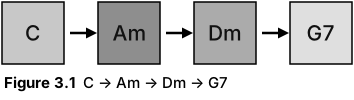
With sevenths:
Cmaj7 → Am7 → Dm7 → G7
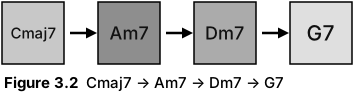
This is the harmonic engine behind a huge amount of jazz, pop, doo-wop, standards, and turnarounds.
The main lesson is:
You can spend a very long time on four chords if you keep changing the voicing, bass, rhythm, melody, and function.
3.1First hear the functionIn C:3.2Root motionRoots:3.3Basic triads firstPlay:3.4Add seventhsNow:3.5Look at Cmaj7 → Am7Cmaj7:3.6Am7 → Dm7Am7:3.7Dm7 → G7Dm7:3.8G7 → Cmaj7G7:3.9First shell-voicing drillLH roots:3.10Better voice-leading versionTry RH:3.11Add 9thsTry:3.12Keep common tones where possibleFor example, E can remain through:3.13Hold E on topPlay top note E through the entire progression:3.14Now hold G on topOver:3.15Basic melody-writing exerciseCreate a melody using only:3.16Chord-tone targetingOver Cmaj7, target:3.17One-note-per-chord soloPlay:3.18Add stepwise connectionTry:3.19Turnaround functionWhy is this progression so useful at endings?3.20The classic turnaroundI → vi → ii → V3.21In FI: Fmaj73.22In GGmaj7 → Em7 → Am7 → D73.23In B♭B♭maj7 → Gm7 → Cm7 → F73.24Bass-line versionInstead of roots:3.25Chromatic bass turnaroundTry:3.26Compare the two loopsClassic:3.27Secondary-dominant upgradeReplace Am7 with A7:3.28Hear the crucial chromatic lineOriginal:3.29Rich turnaroundTry:3.30Secondary dominant of viYou can also strengthen Am:3.31The six-chord chainC → E7 → Am → A7 → Dm → G7 → C3.32Add the iii chordAnother common turnaround variant:3.33Why iii worksEm7:3.34Full circle extensionTry:3.35Start even earlierAdd:3.36But don't extend foreverThe point is not to create a 14-chord route into C.3.37Diminished substitution for A7A7♭9 contains:3.38CompareA7 → Dm3.39Tritone substitute for G7Replace:3.40Tritone substitute for A7A7’s substitute is E♭7.3.41Use only one substitution firstA musical version might be:3.42Backdoor endingInstead of G7 → C, try:3.43Pop versionNow strip the jazz away.3.44Doo-wop-style loopA classic old-pop/doo-wop flavor often centers on:3.45Hear F versus DmC → Am → F → G3.46Waltz versionPut:3.47Bossa versionSame progression:3.48Ballad versionLH: single low root.3.49Swing versionSame harmony.3.50Bluesy versionOver C-major tonic material, introduce:3.51Improv exercise: one scale firstOver the purely diatonic version:3.52Don't think four modesYes, theoretically:3.53When A7 appears, change one noteNow progression:3.54When E7 appearsCmaj7 → E7 → Am.3.55One motif through four chordsChoose:3.56Sequence by functionYou can also keep relative interval roles.3.57Hear the top linePlay:3.58Create a contrary bassTop line rises.3.59Repeated-note reharmonization exerciseHold melody G.3.60Hold melody EUnder:3.61Turnaround as introA song in C can begin with:3.62Turnaround as interludeBetween verses:3.63Turnaround as endingIf you want to prolong ending:3.64Three-stage tagFirst:3.65Counterpoint versionKeep top melody simple.3.66Passing diminished between I and iiTry:3.67Substitute vi with VI7Classic:3.68Substitute ii with II7Try:3.69Dominant-chain turnaroundC → A7 → D7 → G7 → C3.70Hear the chromatic thirdsA7:3.71Compare three versionsCmaj7-Am7-Dm7-G7.3.72Diminished-chain colorBecause dominant ♭9 chords contain diminished sevenths, you can replace portions of the dominant chain with diminished chords.3.73Don't let theory produce a “chord soup”Once again:3.74Workshop challenge: same loop, six stylesPlay the same four-bar skeleton:3.75Jazz ballad treatmentCmaj93.76Swing treatmentSame chords.3.77Pop treatmentCadd93.78Waltz treatmentOne chord per 3/4 bar.3.79Bossa treatmentC6/93.80Blues-influenced treatmentUse C6/C7-type tonic.3.81Workshop challenge: melody over the loopWrite an 8-bar melody where the chord progression repeats twice.3.82Example structurePhrase A:3.83Keep the melody mostly chord-tone basedFirst version:3.84Add one non-diatonic noteIf using A7:3.85Add one borrowed chordNear the final tonic:3.86Build a complete mini-standardForm:3.87Relative-minor bridgeIn C, move bridge to Am.3.88IV-centered bridgeMove toward F:3.89Ear training with the loopHave someone—or yourself randomly—omit one chord.3.90Sing the inner linesOver:3.91Transpose the loop every dayDon't do all 12 keys immediately if that's tedious.3.92Fast transposition methodIf tonic is D:3.93Minor version of the conceptIn A minor, a related turnaround might be:3.94The ultimate one-loop improv drillLoop:3.95The ultimate comping drillSame loop.3.96The ultimate ear drillPlay the loop.3.97The larger lessonA progression like I–vi–ii–V seems simple because there are only four chords.•Homework — Workshop 3Play:•Workshop 3 mini-test1. What is I–vi–ii–V in C?