Module 13 — Extensions: 9ths, 11ths, and 13ths
This is where chord symbols start looking scary:
Cmaj9
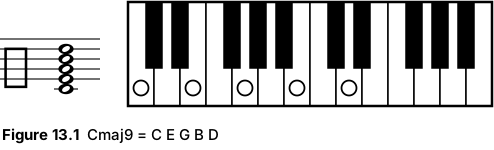
Dm11 G13 G7♭9 A13sus4
But the underlying idea is simple:
Extensions are just notes added above the 7th chord by continuing to stack thirds.
You already know:
1 – 3 – 5 – 7
Keep going:
9 – 11 – 13
Those are basically:
2 – 4 – 6, but counted an octave higher.
So:
- 9 = 2
- 11 = 4
- 13 = 6
Same pitch class, different harmonic role.
13.1Start with Cmaj7C major scale:13.2But pianists normally do NOT play all seven notesThis is essential.13.3Why are they called 9, 11, and 13?Because chord notation assumes stacked thirds.13.4Cadd9 is not the same as Cmaj9This distinction matters.13.5C9 means dominant 9, not major 9This follows the same rule we learned for 7ths.13.6Cm9Minor 9:13.7The three most useful 9th chordsLearn these first:13.8Practical 9th voicingsYou rarely need all five notes.13.9Apply this to ii–V–IIn C:13.10One of our favorite voicingsFrom Module 11:13.11What is an 11th?Take a seventh chord and add:13.12This is why major 11 chords are less straightforwardIf you see:13.13Minor 11 works beautifullyNow try:13.14Dm11 is especially usefulIn C major:13.15What is a 13th?13 = scale degree 6.13.16G13 does not mean seven simultaneous notesA very practical G13:13.17Why omit the 11th on G13?G13 theoretically includes C.13.18The hierarchy of important notesFor many jazz chords, think approximately:13.19Example: G13Theoretical notes:13.2013 versus 6Another notation distinction.13.216/9 chordA common pleasant major chord:13.22Compare tonic colorsPlay:13.23The chord symbol is increasingly becoming a menuWhen you see:13.24Extensions and melodySuppose chord is Cmaj7 and melody is D.13.25Melody A over Cmaj7A is 13.13.26Melody F over Dm7Dm7:13.27Don't double the color tone unnecessarilyIf melody is D over Cmaj9, don't feel obligated to add another D lower down.13.28Tensions versus extensionsJazz theory often calls 9, 11, and 13 tensions.13.29Altered extensionsExtensions can be altered:13.30Hear G7 versus G7♭9Play:13.31Where does the ♭9 come from?For G7 resolving to C minor, G7♭9 is especially natural.13.32Dominant ♯9G7♯9:13.33♯11On a major chord:13.34Dominant ♭13G7♭13:13.35Don't memorize every altered dominant yetFor now, just understand the notation.13.36Extension notation assumes the 7thA subtle but important rule:13.37`add` notationadd9:13.38`sus` is differentWe'll cover suspensions more fully later, but:13.39Dominant susG7sus413.40Try this progressionDm7 → G7sus4 → G7 → Cmaj713.41Extensions are color, not functionThis is one of the most important ideas in this module.13.42Same progression, richer colorsBasic:13.43Voice-leading the colorsTry:13.44A melody can determine which extension to chooseSuppose you're on G7.13.45Chord symbol may describe the whole vertical soundSuppose:13.46Upper structuresHere's a preview of a more advanced jazz idea.13.47Extension ear trainingPlay:13.48Don't obsess about exact labels when playingSometimes the exact complete chord might technically be:13.49A useful minimal voicing libraryMemorize these in C:13.50Notice the shape patternMajor 9:13.51Transpose the formulasGmaj9:13.52Add extensions to secondary dominantsOur Module 12 progression:13.53Do not make every chord extendedContrast matters.13.54The melody gets priorityIf your extension conflicts badly with the melody:13.55Practical chord-building workflowWhen you see:13.56Another example: Dm111. Root D 2. Minor 3rd F 3. Minor 7th C 4. 9 = E 5. 11 = G 6. 5th A optional13.57Another: Fmaj91. root F 2. 3 = A 3. 7 = E 4. 9 = G13.58Your first rich progressionPlay slowly:13.59Improvising over extensionsIf chord is:13.60Extensions can become melody targetsOver Dm9:•Homework for Module 13Spend around 30 minutes.•Module 13 mini-test1. What are 9, 11, and 13 equivalent to within one octave?