BookatlasPiano Rabbit Hole: Improvisation Theory & Practice

Workshop 111 — Composing Harmonic Rhythm and Pacing: How Fast the Harmony Changes, When It Stands Still, and Why Timing Can Matter More Than Chord Choice

Workshop 110 was about development: how one idea transforms without losing its identity.

Now we focus on something more subtle:

how quickly the harmonic world itself changes.

Two compositions can use exactly the same chords:

Cmaj7 → Am7 → Dm7 → G7
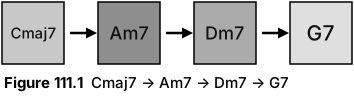
Cmaj7 → Am7 → Dm7 → G7

and feel completely different simply because one gives each chord:

while another gives them:

The chord vocabulary is identical.

But the listener experiences:

different gravity

different urgency

different phrase shape

different formal scale.

This is harmonic rhythm.

The central lesson of Workshop 111 is:

Harmony is not only a sequence of chords. It is a sequence of durations, and those durations tell the listener which harmonies are structural, which are transitional, where the music is resting, and where it is beginning to move faster toward something important.

111.1DefinitionHarmonic rhythm means:27 words111.2Important distinctionSuppose you play:27 words111.3We therefore need multiple clocksYou can think of:22 words111.4ExampleBass:37 words111.5First principleDo not confuse “more chord symbols” with “more harmonic motion.”20 words111.6Level 1 — one chord for four barsTake:22 words111.7Why this mattersIf you cannot sustain one harmony:19 words111.8Level 2 — one chord every two barsProgression:23 words111.9Level 3 — one chord per barSame progression.14 words111.10Level 4 — two chords per barC Am | Dm G7 | C Am | Dm G7.22 words111.11Level 5 — four chords per barAt moderate tempo:23 words111.12This is foundationalThe same chord can be:16 words111.13Level 6 — structural durationHold tonic:21 words111.14Harmonic rhythm is therefore a form of hierarchyLonger does not always mean more important.11 words111.15Level 7 — harmonic accelerationStart:17 words111.16ExampleBars 1–2: C.24 words111.17Level 8 — harmonic decelerationReverse.21 words111.18Tonic becomes bigger when harmonic rhythm slows thereThis is a strong cadential device.6 words111.19Level 9 — dominant accelerationStay in tonic/predominant regions calmly.29 words111.20Level 10 — dominant freezeOpposite.25 words111.21Stasis can be tenseThis is important.18 words111.22Harmony has two dimensionsRate of change10 words111.23Level 11 — high tension, slow rhythmG7alt for 2 bars.10 words111.24Level 12 — low tension, fast rhythmCmaj7 → Am7 → Em7 → C/E etc.18 words111.25This distinction is powerfulYou can create activity without increasing:14 words111.26Level 13 — functional accelerationTonic region: 4 bars.18 words111.27Level 14 — functional decelerationDominant arrives early.16 words111.28Level 15 — harmonic-rhythm phraseWrite an 8-bar phrase whose chord-duration pattern is:29 words111.29Harmonic rhythm can be thematicIf every phrase uses:10 words111.30Level 16 — harmonic-rhythm motifExample:20 words111.31Level 17 — change chords, preserve durationsProgression A:22 words111.32Level 18 — preserve chords, change durationsSame chords.14 words111.33Harmonic rhythm can distinguish A and B without new chord vocabularyA: one chord/bar.12 words111.34Level 19 — one-chord A, active BA: C pedal/modal.14 words111.35Level 20 — active A, static BA: many changes.13 words111.36Harmonic rhythm is therefore a texture/form parameterNot merely theory.3 words111.37Level 21 — melody versus harmonic rhythmBusy melody:17 words111.38ExampleMelody holds G for 2 bars.23 words111.39Level 22 — busy melody, frozen harmonyRapid melodic phrase.12 words111.40Level 23 — sparse melody, active harmonyMelody:12 words111.41Complexity budget applies temporallyBusy melody + fast harmony + active bass + dense inner counterpoint:20 words111.42Level 24 — bass rhythm versus harmonic rhythmBass can move while harmony stays.19 words111.43Level 25 — harmony changes while bass staysC pedal.14 words111.44These independent clocks create sophisticationWithout needing:4 words111.45Level 26 — root rhythmTrack only:22 words111.46Level 27 — bass rhythmBass may change:14 words111.47Level 28 — voicing rhythmSame chord:12 words111.48Level 29 — extension rhythmCmaj7 → Cmaj9 → C6/9 → Cmaj7♯11.16 words111.49Level 30 — tension rhythmOver G dominant:16 words111.50Level 31 — tension can decrease while harmony remains dominantG7alt15 words111.51Level 32 — no change at barlineAvoid automatic rule:19 words111.52Level 33 — chord change off the barlineChange harmony on:14 words111.53Level 34 — anticipate chordUpcoming chord expected beat 1.17 words111.54Level 35 — delay chordKeep previous harmony on beat 1.16 words111.55Harmony itself can be syncopatedNot just comping rhythm.15 words111.56Level 36 — bass arrives before harmonyBass changes to next root:18 words111.57Level 37 — harmony arrives before bassRH changes:12 words111.58Level 38 — melody arrives before bothMelody anticipates new chord tone.19 words111.59Level 39 — design arrival orderFor important harmonic event choose:16 words111.60Level 40 — harmonic rhythm and tempoA progression at 60 BPM with:30 words111.61This matters during tempo changesIf you double tempo:17 words111.62Level 41 — preserve harmonic event rate across double-timeAt 60 BPM:19 words111.63Level 42 — intentionally accelerate with tempoDouble tempo but keep:15 words111.64Level 43 — half-time illusionTempo unchanged.13 words111.65Level 44 — rhythm speeds up but harmony slowsVery effective.15 words111.66Level 45 — slow groove, fast harmonyBallad with:15 words111.67Harmonic event rate is style-dependentA fast bebop standard can tolerate:23 words111.68Level 46 — swing harmonic rhythmTraditional standards often:19 words111.69Level 47 — ballad harmonic rhythmSlow tempo gives time for:18 words111.70Level 48 — bossa harmonic rhythmOften regular but smooth.18 words111.71Level 49 — funk harmonic rhythmOften extremely slow functional movement.19 words111.72Level 50 — gospel harmonic rhythmMay become active near:16 words111.73Level 51 — stride harmonic rhythmBass/chord alternation can create surface attacks twice per bar or more.25 words111.74Level 52 — modal harmonic rhythmA modal field can last:18 words111.75Level 53 — blues harmonic rhythmThe 12-bar form has relatively slow structural harmonic rhythm:25 words111.76Level 54 — pop-loop harmonic rhythmFour chords repeating every:17 words111.77Level 55 — harmonic rhythm as lyric pacingEven without actual lyrics:23 words111.78Level 56 — long note = harmonic windowWhen melody sustains:17 words111.79Level 57 — rest = harmonic windowMelody rests.12 words111.80Level 58 — melodic climax with slow harmonyAt highest note:17 words111.81Level 59 — melodic climax with harmonic accelerationOpposite can work if:18 words111.82Level 60 — pre-climax accelerationOne of the most reliable compositional tools.13 words111.83Example4 bars tonic.19 words111.84Level 61 — post-climax decelerationAfter peak:12 words111.85Level 62 — no post-climax tonic immediatelyYou can decelerate on:14 words111.86Level 63 — harmonic freeze at climaxEverything builds.13 words111.87Level 64 — harmonic silence at climaxPerhaps no chord.16 words111.88Harmonic rhythm includes zeroSilence11 words111.89Level 65 — omission as prolongationIf G7 is established:22 words111.90Listener memory can sustain harmonyThis is why literal chord repetition isn't always required.9 words111.91Level 66 — harmonic rhythm and formA section can be identified by:25 words111.92Level 67 — harmonic-rhythm callbackOpening: one chord every 2 bars.20 words111.93Level 68 — harmonic-rhythm foreshadowingBefore B:15 words111.94Level 69 — harmonic-rhythm deceptionListener expects cadence acceleration.16 words111.95Level 70 — acceleration without destinationDanger.21 words111.96Level 71 — destination mapBefore writing harmonic rhythm, mark:19 words111.97Level 72 — harmonic rhythm backward from cadenceChoose cadence:21 words111.98Level 73 — harmonic rhythm backward from climaxClimax bar:22 words111.99Level 74 — layered accelerationDo not accelerate all clocks together.23 words111.100Level 75 — layered decelerationAfter climax:19 words111.101Harmonic rhythm is closely related to breathingYou need:10 words111.102Level 76 — irregular harmonic rhythmInstead of:17 words111.103Level 77 — long-short-long patternChord A: 2 bars.17 words111.104Level 78 — asymmetric harmonic phraseExample:23 words111.105Level 79 — 3+3+2 harmonic groupingThree bars tonic region.14 words111.106Level 80 — 2+2+4Two bars home.14 words111.107Level 81 — harmonic-rhythm polymeterAdvanced.16 words111.108ExampleEach harmony lasts:22 words111.109This is strong rhythmic tensionKeep melody/pulse simpler.7 words111.110Level 82 — 5-eighth harmonic cycleEach upper harmony lasts:17 words111.111Harmonic rhythm can participate in polymetric illusionNot only melody/bass.3 words111.112Level 83 — syncopated functional arrivalPredominant begins:16 words111.113Level 84 — tonic offbeatFor funk/pop:14 words111.114Level 85 — cadence after barlineExpected tonic:20 words111.115Level 86 — cadence before barlineTonic on:15 words111.116A barline is not automatically a harmonic boundaryThis should become deeply internalized.5 words111.117Level 87 — harmonic rhythm and melody phrase independenceMelody phrase crosses:19 words111.118Level 88 — harmony phrase longer than melody phraseTwo melodic phrases over one harmonic region.17 words111.119Level 89 — harmony phrase shorter than melody phraseOne long melody spans several harmonic events.14 words111.120Level 90 — design independent phrase clocksWrite:21 words111.121Level 91 — re-alignment as climaxIndependent cycles finally coincide:21 words111.122Level 92 — deliberately avoid alignmentAt local cadence:25 words111.123Level 93 — harmonic rhythm as compositional identitySome pieces are recognizable partly because:20 words111.124Level 94 — write chord-duration pattern before chordsExample:17 words111.125Level 95 — write emotional pacing before harmonyMark:15 words111.126Level 96 — harmonic-rhythm constitutionFor a piece decide:21 words111.127Level 97 — violate the constitution onceIf B is always active:19 words111.128Level 98 — harmonic rhythm and surprise budgetA rare:28 words111.129Level 99 — harmonic rhythm in generative arrangementUsing Workshop 101:25 words111.130Level 100 — real-time pacing decisionWhile improvising/arranging ask:34 words111.131Harmonic-rhythm fatigueConstant:16 words111.132Harmonic-rhythm stagnationOne chord for too long without:18 words111.133Balance lawWhen one musical clock slows, another can become more active.28 words111.134Level 101 — stable harmony, active counterpointC pedal.19 words111.135Level 102 — active harmony, minimal counterpointMany changes.9 words111.136Level 103 — active bass, static functionWalking bass over:14 words111.137Level 104 — active color, static bass/functionGreat for:10 words111.138Level 105 — harmonic acceleration through substitutionBaseline:24 words111.139Level 106 — reharmonization by subtractionSuppose original:39 words111.140This is crucialMore sophisticated arrangement may require:7 words111.141Level 107 — prolong structural chord, omit connectorC → C♯°7 → Dm.19 words111.142Level 108 — insert connector only on repeatFirst A: simple.12 words111.143Level 109 — remove connectors at final returnInteresting reverse.13 words111.144Level 110 — cadence duration hierarchyFirst cadence: short tonic.14 words111.145Level 111 — deceptive cadence durationG7→Am.20 words111.146Tonicization versus modulation partly depends on timeA temporary destination becomes more structurally significant if:18 words111.147Level 112 — brief foreign chord = colorA♭maj7 for 1 beat.6 words111.148Level 113 — foreign chord for 8 barsNow:9 words111.149Duration changes ontologyA passing event can become:12 words111.150Level 114 — make a color become a placeEarly:22 words111.151Level 115 — make a place become a colorEarlier: A♭ is full B section.23 words111.152Harmonic rhythm can encode memoryDuration of recurrence can change:11 words111.153Practice Loop A — same chords, four ratesUse:19 words111.154Practice Loop B — accelerationEight bars.18 words111.155Practice Loop C — decelerationStart active.12 words111.156Practice Loop D — color rhythmHold:17 words111.157Practice Loop E — harmonic syncopationWrite 8 bars where:16 words111.158Practice Loop F — melody/harmony independenceWrite:21 words111.159Practice Loop G — harmonic-rhythm formA: slow.15 words111.160Improvisation Challenge 1 — no chord changes for 8 barsOne harmony.10 words111.161Challenge 2 — maximum one functional change every 2 barsYou may change:16 words111.162Challenge 3 — harmonic acceleration without getting louderBuild tension entirely through:11 words111.163Challenge 4 — freeze at expected cadenceAccelerate strongly.15 words111.164Challenge 5 — offbeat tonicCreate cadence where tonic arrives:17 words111.165Challenge 6 — slow harmonic rhythm over fast grooveFunk or straight 16ths.12 words111.166Ear Drill — function versus colorPlay:17 words111.167Ear Drill — structural durationPlay:19 words111.168Ear Drill — duration changes meaningPlay A♭ in C:21 words111.169Ear Drill — acceleration expectationPlay progressively shorter chord durations.17 words111.170Ear Drill — delayed cadenceEstablish expected tonic timing.20 words111.171Mini-project 1 — Harmonic-Rhythm CompositionWrite 16 bars using only:57 words111.172Mini-project 2 — One Progression, Three FormsUse:35 words111.173Mini-project 3 — Independent ClocksWrite 12–16 bars where:34 words111.174Mini-project 4 — Harmonic Freeze ClimaxBuild using accelerating changes for 12 bars.29 words111.175Mini-project 5 — Reharmonize by SubtractionTake one of your harmonically rich original pieces.25 words111.176Mini-project 6 — Color Becomes PlaceIntroduce one foreign harmony early for:28 words111.177Apply to “Happy Birthday”Because the melody is public domain, use it fully.64 words111.178Happy Birthday structural experimentPhrase 1: keep mostly tonic.28 words111.179Conceptual “Mack the Knife”Repeated choruses give a perfect pacing laboratory.36 words111.180Conceptual “The Bare Necessities”Its rhythmic identity can be damaged by overactive harmony.35 words111.181The deeper harmonic lessonHarmony is partly:30 words111.182The deeper melodic lessonMelody and harmony need not share:29 words111.183The deeper bass lessonBass movement does not equal:23 words111.184The deeper counterpoint lessonInner voices can generate:22 words111.185The deeper form lessonSections can differ simply by:17 words111.186The deeper transition lessonA section can begin transforming before its boundary by:21 words111.187The deeper development lessonDevelopment can occur without new chords.16 words111.188The deeper improvisational lessonWhen improvising, do not constantly ask:29 words111.189The editing questionFor every chord change ask:30 words111.190The duration questionAsk:23 words111.191The pacing questionAsk:17 words111.192The stagnation questionAsk:24 words111.193The cadence questionBefore a cadence ask:17 words111.194The climax questionShould climax have:18 words111.195The mature harmonic-rhythm questionNot:58 wordsWorkshop 111 mini-test1. What is harmonic rhythm?483 words
← PreviousWorkshop 110 — Writing Development Sections: How to Take One Idea Farther Without Losing Its Identity