2319 / 18210 · Workshop 3 — I–vi–ii–V: Turnarounds, Standards, and Making Four Chords Do a Lot← prev⊞ allnext →
Homework — Workshop 3
A. Memorize the loop
Play:
Cmaj7-Am7-Dm7-G7
without looking.
Say:
I-vi-ii-V.
B. Transpose
Play I–vi–ii–V in:
C
F
G
B♭
D.
C. Shells
Use LH roots and RH 3rd/7th only.
Minimize movement.
D. Color version
Play:
Cmaj9-Am9-Dm9-G13
then:
Cmaj9-A7-Dm9-G13.
Compare.
E. Dominant-chain version
Practice:
Cmaj7-A7-D7-G7-C
Hear each altered third.
F. Tritone version
Practice:
Cmaj7-A7-Dm7-D♭7-Cmaj7.
Hear:
D → D♭ → C
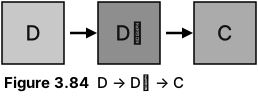
in bass.
G. One-note melody
Hold E through:
C-Am-Dm-G-C.
Then hold G through the same progression.
Identify each note's function.
H. Motif improvisation
Create one 3-note motif.
Use it for four full choruses.
Change only:
pitch level
ending
rhythm slightly.
Do not abandon it after two bars.
I. Six styles
Play the same loop as:
- jazz ballad
- swing
- pop
- waltz
- bossa
- blues-influenced
Record at least three of them.
J. Compose 8 bars
Write an 8-bar melody over:
C-Am-Dm-G | C-Am-Dm-G
Use:
- one recognizable motif
- different second ending
- one phrase that ends open
- final resolution to C
Then create a second harmonization using A7 instead of Am7.