Homework for Module 18
Spend about 30–35 minutes.
A. Major scale with targets
Loop:
Dm7-G7-Cmaj7
Use C major throughout.
Deliberately target:
F → B → E
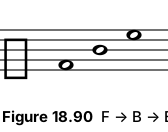
Then:
C → F → B
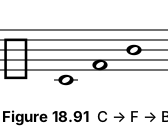
B. Dorian
Loop Dm7.
Compare:
D natural minor
with:
D Dorian.
Make B versus B♭ obvious.
C. Mixolydian
Loop G7.
Use:
G A B C D E F
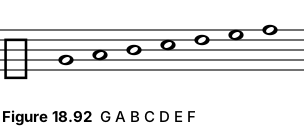
Create phrases that emphasize F, A, and E.
D. Major pentatonic
Loop Cmaj7.
Use only:
C D E G A
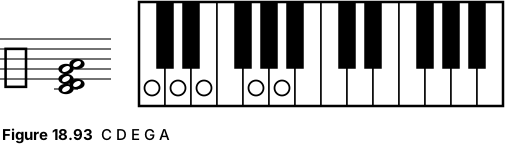
Make 2-bar phrases with rests.
Do not play it straight up and down.
E. Minor pentatonic
Loop Am7.
Use:
A C D E G
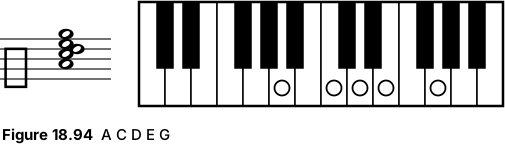
Then add B as a color note and hear what changes.
F. Blues
Loop C7.
Use:
C E♭ F G♭ G B♭
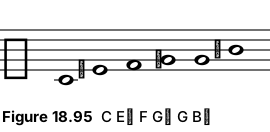
Practice:
E♭ → E
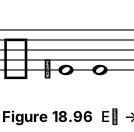
and:
G♭ → G
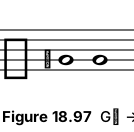
as expressive resolutions.
G. Lydian
Loop Cmaj7.
Compare:
F natural
with:
F♯.
Then improvise using C Lydian and deliberately feature F♯.
H. One-color-note exercise
Over:
Dm7, use chord tones + E only.
Over G7, chord tones + E only.
Over Cmaj7, chord tones + D only.
Notice:
E = 9 over Dm
E = 13 over G
D = 9 over C.
I. Avoid scale runs
For five minutes, forbid yourself from playing more than three consecutive scale-wise notes in one direction.
Use:
- leaps
- repetitions
- rests
- direction changes
- motifs