Homework — Workshop 7
A. Melody only
Play the whole tune without accompaniment.
Shape phrases as if singing.
B. Top-note voicing
Practice ten chords where the melody note is clearly louder than inner notes.
Record yourself.
C. Melody-as-extension
For five melody notes, identify whether each functions as:
- root
- 3rd
- 5th
- 7th
- 9th
- 11th
- 13th
under the chord.
D. Sparse ballad voicings
Play a full section using:
LH root
RH melody + no more than two inner notes.
Keep it beautiful.
E. ii–V–I
Practice:
Dm9 → G13 → Cmaj9
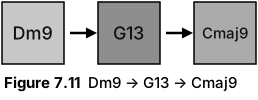
with minimal RH movement.
Then transpose to three keys.
F. Suspensions
Practice:
G13sus → G13 → Cmaj9
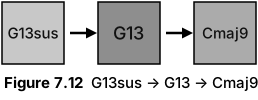
and:
G7 → C with F→E delayed
Make the delayed resolution audible.
G. Inner voice
Under one long melody note, create a 3–4 note inner line.
Keep melody held.
H. Reharmonization
Choose one long melody note.
Create three different harmonizations beneath it.
Use different bass lines.
Choose the most musical by ear.
I. Rubato
Record one phrase:
strict
then with restrained rubato.
Listen for whether the pulse still feels internally secure.
J. Complete ballad arrangement
Include:
- short rubato intro
- sparse first statement
- richer second section
- one reharmonized long note
- one inner counter-line
- one suspension
- one clear climax
- intentional simplification afterward
- designed ending