Homework for Module 16
Spend around 30 minutes.
A. One note per chord
Over:
Dm7 → G7 → Cmaj7
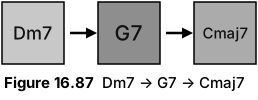
create 10 different three-note lines.
Every note must be a chord tone.
B. Thirds and sevenths
Play:
3rds:
F → B → E
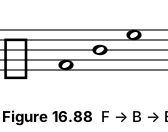
then 7ths:
C → F → B
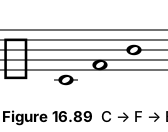
Then create melodies approaching each target.
C. Dominant resolution
Practice melodically:
B → C
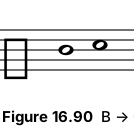
and:
F → E
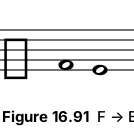
over:
G7 → Cmaj7
Use different rhythms.
D. Chord tones only
Loop ii–V–I.
Improvise using only chord tones.
Do this for at least five minutes before adding scale tones.
E. Passing notes
Add diatonic passing tones between chord-tone targets.
Keep track mentally of which note is the destination.
F. Chromatic approaches
Approach:
F over Dm7
B over G7
E over Cmaj7
from a semitone above and below.
Then try simple enclosures.
G. Motif
Create one 2–4 note motif.
Use it for an entire chorus.
Allow yourself to change:
- one pitch
- starting beat
- rhythm
- direction
but keep the family resemblance.
H. Space
Improvise for one chorus with the rule:
after every phrase, leave at least one full beat of silence.
Then try two beats.
I. Secondary dominant line
Over:
Cmaj7 → E7 → Am7
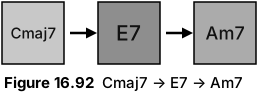
make G → G♯ → A audible.
Over:
Am7 → A7 → Dm7
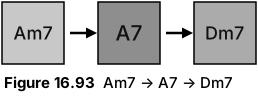
make C → C♯ → D audible.
J. Sing first
Play the progression with LH.
Sing/hum a 2-bar phrase.
Then find it with RH.
Do this five times.