Homework — Workshop 5
A. Basic form
Play 12-bar C blues without looking.
Say bar numbers aloud.
B. Quick change
Play the quick-change version with F7 in bar 2.
Switch between basic and quick-change forms without stopping.
C. Shells
Play all 12 bars using:
LH roots
RH 3rd/7th only.
Make every change smooth.
D. Blue-third drill
Practice:
E♭→E
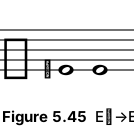
over C7.
A♭→A
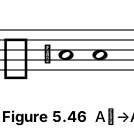
over F7.
B♭→B
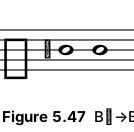
over G7.
Then use each in a short phrase.
E. Form targets
Improvise one chorus where:
bar 5 must land on A.
bar 9 must land on B.
bar 11 must clearly return toward C7.
F. AAB solo
Create:
bars 1–4 = statement.
5–8 = related variation.
9–12 = answer.
Use only one 3-note motif.
G. Jazz-blues changes
Practice:
| C7 | F7 | C7 | Gm7 C7 | | F7 | F♯°7 | C7/G | A7 | | Dm7 | G7 | C7 A7 | Dm7 G7 |
First roots.
Then shells.
Then full chords.
H. Tritone substitutions
Practice:
Gm7 → G♭7 → F7
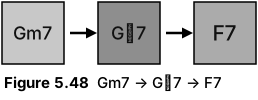
and:
Dm7 → D♭7 → C7.
Listen to the chromatic bass.
I. Walking bass
Create a basic quarter-note walking line for all 12 bars.
Prioritize:
- root on new chord
- chord tones
- chromatic approach into bars 5 and 9
Do not worry about sophistication.
J. Four-chorus solo
Record:
Chorus 1
minor pentatonic, sparse.
Chorus 2
major/minor mixture.
Chorus 3
chord-tone targeting.
Chorus 4
motif development over jazz-blues changes.
Listen for whether intensity grows naturally.