Homework for Module 26
A. Four-chord loop
Practice:
C-G-Am-F
in:
- root position
- smooth RH inversions
- G/B version
- add9/7 version
Compare.
B. Transpose by number
Play:
I-V-vi-IV
in:
C
G
D
F
without thinking of each as a new progression.
C. Three textures
Play the same progression as:
- whole-note ballad
- quarter-note pop pulse
- syncopated pattern
No chord changes.
Hear how style changes.
D. Common top note
Keep G as top note through:
C → G → Am7 → Fadd9
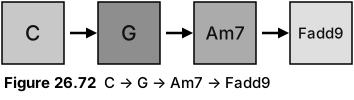
Find workable voicings underneath.
Then do the same with E where possible.
E. Bass-line exercise
Practice:
C → G/B → Am → Em/G → F → C/E → Dm → G

Play bass alone first.
Then add RH.
F. Pop chord colors
Compare:
C
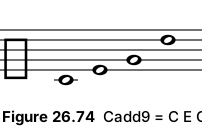
Cadd9
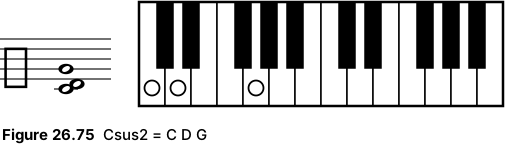
Csus2
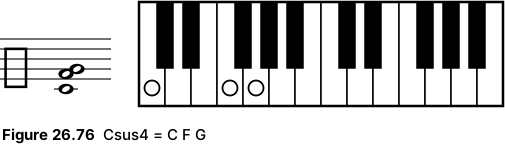
Csus4
Cmaj7
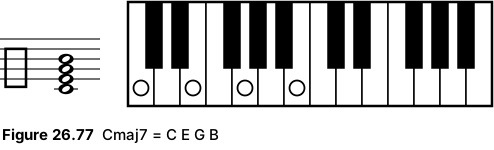
Identify which sound most naturally belongs to different pop moods.
G. Build across sections
Play four repetitions of C-G-Am-F:
1
single roots + sparse RH.
2
add rhythm.
3
LH octaves + full RH.
4
drop suddenly back to sparse.
Record and listen for the structural effect.
H. Ostinato
Create a 2–4 note RH pattern.
Repeat it over:
C-G-Am-F.
Change the minimum number of notes necessary.
I. Melody fills
Use only C major pentatonic:
C-D-E-G-A
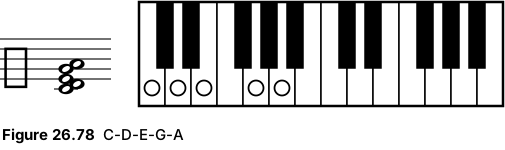
Create fills of no more than four notes.
Leave at least one beat of silence afterward.
J. Complete pop arrangement
Take a simple pop-style melody and create:
- intro
- sparse verse
- build
- full chorus
- breakdown
- final chorus
- deliberate ending
Use no more than one borrowed chord and one secondary dominant.
Force yourself to create the rest of the variety through arrangement rather than harmonic complexity.